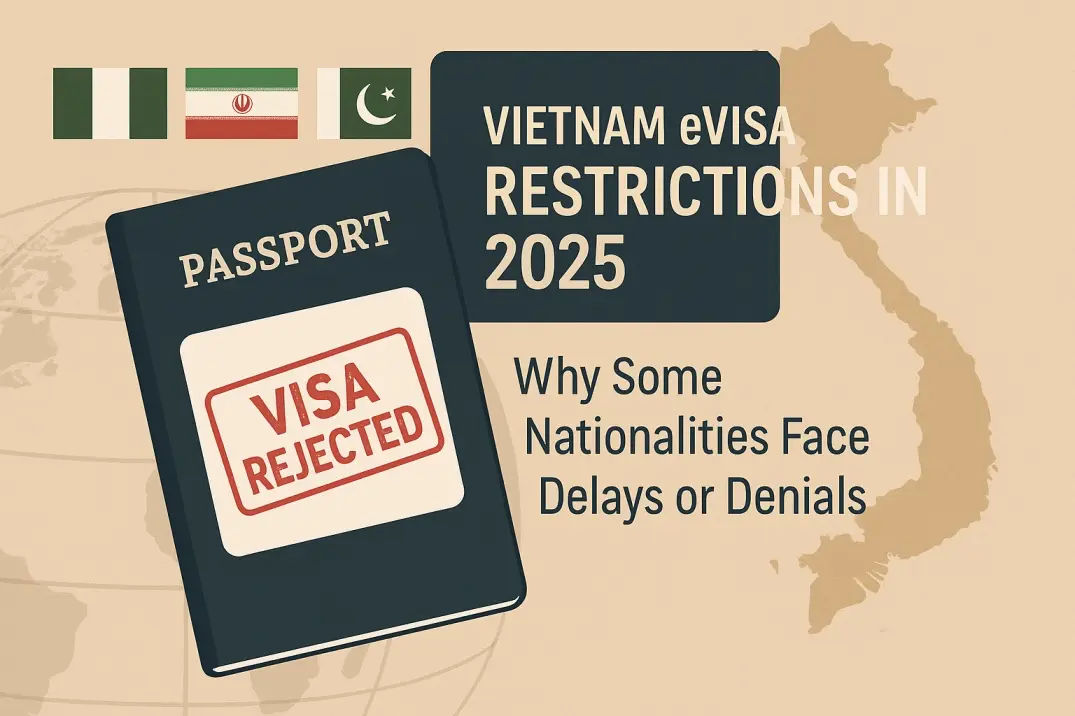
Vietnam eVisa applications are rejected more often than the immigration portal suggests. Most rejections come from avoidable documentation errors: a wrong photo format, a mismatched date, or an address that doesn’t verify. A smaller number of rejections are nationality-based, where Vietnam’s Immigration Department applies stricter manual review to applicants from specific countries.
This page covers the seven most common rejection reasons, what the “difficult nationalities” classification means in practice, and what you can do after a denial.
Why did my Vietnam visa get rejected?
Vietnam’s Immigration Authority rejects eVisa applications for two broad categories of reasons: errors in the application itself, and nationality-based screening. The seven reasons below cover both. The first six apply to all nationalities. The seventh applies specifically to countries on the restricted list.
One rule applies across all cases: a visa application will be denied if the Vietnam Immigration Authority finds any dishonest or unverifiable information in the application. This includes false hotel addresses, altered passport details, or travel history that contradicts the supporting documents.
1. Incorrect or low-quality passport photos
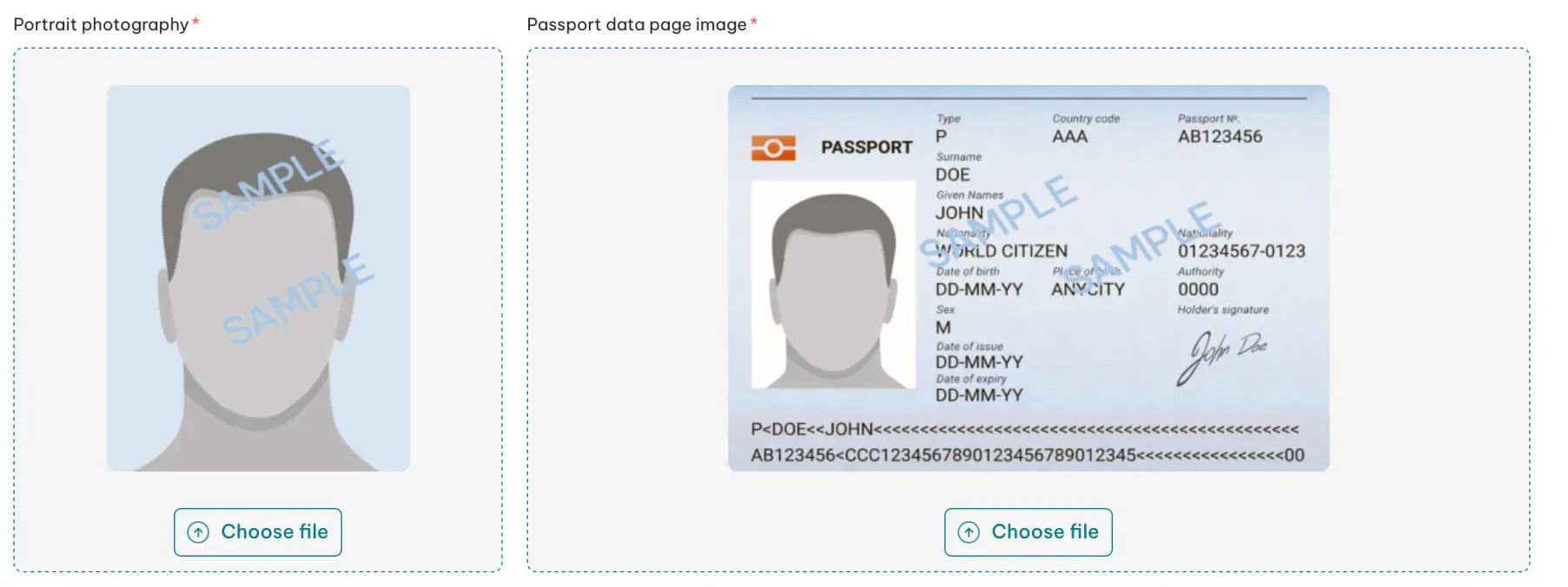
The eVisa application requires two separate images: a passport-style portrait photo and a scan of your passport bio page. These go in different upload fields. Uploading the same image twice, or placing them in the wrong fields, is one of the most common technical rejection causes.
Requirements for the portrait photo:
- White or plain background
- Taken recently (within the last 6 months)
- Face the camera directly, no glasses, no hats
- No tank tops or sleeveless clothing
- File format: JPG or PNG, under 2MB
- Do not crop a photo from your passport page and use it here — it will fail the quality check
Requirements for the passport bio page scan:
- Full page visible, including the ICAO machine-readable lines at the bottom
- No glare, no shadows, no cropping of corners
- File format: JPG or PNG, under 2MB
Prepare both images before you start the application. The system auto-fills some fields from the passport scan, but a poor-quality scan produces incorrect auto-fills that you then have to catch and correct manually.
2. Errors in personal information
The application pulls data from your uploaded passport scan, but it does not always read accurately. Check every field manually before submitting. Border officers compare your visa against your physical passport at entry; any mismatch is grounds for refusal even if the visa was approved online.
Fields that most often contain errors:
- Last name (surname) — must match your passport exactly, including hyphenated names
- Date of birth — use DD/MM/YYYY format, not MM/DD/YYYY
- Passport number — check for zeros vs. the letter O, and 1 vs. the letter I
- Passport issue date and expiry date — both must match exactly
Your last name in the application must also match the ICAO line on your passport (the two machine-readable lines at the bottom of the bio page). Special characters such as accents or hyphens sometimes cause mismatches. If your name contains special characters, enter it exactly as it appears in the ICAO line, which uses only standard Latin letters.

3. False or unverifiable accommodation address
The application requires the address of your first night’s accommodation in Vietnam. This must be a real, bookable address. Vietnam’s Immigration Department cross-checks submitted addresses and contacts accommodation providers in cases it flags for review. Submitting a random address or a placeholder is recorded as dishonest information and results in rejection.
If you have not booked accommodation yet, book a refundable hotel room for the first night before submitting the application. Copy the full address from the hotel’s Google Maps listing or booking confirmation. Cancel the booking after your visa is approved if your plans change.
4. Wrong visa validity dates
The eVisa is valid from the arrival date you enter during the application, not from the date you actually enter Vietnam. You can enter on the start date or any day after it, but you cannot enter before it, and you must leave by the end date.
Common mistake: applicants set the start date to the day they apply, then book flights for three weeks later. When they arrive, they find the visa has already used up 21 days of its validity period.
Set the start date to the day you plan to fly into Vietnam, or up to a few days before to give yourself flexibility. The eVisa is valid for up to 90 days single or multiple entry depending on what you select at application.
5. Applying for a new eVisa while still inside Vietnam
Vietnam does not process eVisa applications submitted from within Vietnam. If your current visa is expiring and you apply for a new one while still in the country, the application will be rejected.
To get a new eVisa, you must leave Vietnam first and apply from outside the country. The application is processed within 3 to 5 working days for most nationalities. Plan your exit and re-entry accordingly.
6. Children’s visas applied incorrectly
Each child with their own passport needs a separate eVisa application. The portal has an option that reads “Under 14 years old accompanying child(ren) included in your passport” — this only applies if your child’s name is physically printed inside your passport, which is rare in current passports.
If you tick this option for a child who has their own passport, the child’s name appears on the parent’s visa only. It does not count as a valid visa for the child. Airlines follow this rule strictly: the child will not be allowed to board.
Submit a separate application and pay a separate fee for each child who holds their own passport.
7. Nationality-based rejection (difficult nationalities)
Applicants from certain countries pass through a manual review process that takes significantly longer than the standard 3 to 5 working days, and which results in a higher rate of rejections. Vietnam’s Immigration Department calls this the “difficult nationalities” classification. The classification is based on visa fraud rates, security considerations, and bilateral agreements with specific countries.
Being from a country on this list does not automatically mean rejection. Many applicants from these countries receive approvals. It does mean the process takes longer, often 4 to 12 weeks, and that the documentation standard is higher.
List of difficult nationalities for Vietnam eVisa (2026)
The following nationalities face extended manual review. This list reflects current Immigration Department practice and may change without public notice. If your nationality is not on this list and your application was still rejected, the cause is almost certainly a documentation error covered in the seven reasons above.
| Nationality | Country code |
|---|---|
| Nigeria | NGA |
| Cameroon | CMR |
| Mozambique | MOZ |
| Congo | COG |
| Ghana | GHA |
| Sierra Leone | SLE |
| Iran | IRN |
| Yemen | YEM |
| Bangladesh | BGD |
| Pakistan | PAK |
| Afghanistan | AFG |
| Syria | SYR |
| Iraq | IRQ |
| Libya | LBY |
| Lebanon | LBN |
| Sudan | SDN |
| Benin | BEN |
| Burkina Faso | BFA |
| Botswana | BWA |
| Ethiopia | ETH |
Applicants from these countries submit their application through the standard national immigration portal. The fee is the same. Only the review timeline and approval rate differ.
Vietnam eVisa rejection for Indian nationals
India is not on the difficult nationalities list. Indian passport holders are eligible for the standard Vietnam eVisa and normally receive a decision within 3 to 5 working days.
When Indian nationals receive a rejection, the cause is almost always one of the documentation errors in reasons 1 through 6 above. The most frequent are photo quality issues, name mismatches between the application and the passport ICAO line, and date format errors (entering MM/DD/YYYY instead of DD/MM/YYYY). Check all fields carefully before submitting and reapply with corrected information.
Can I reapply for a Vietnam visa if rejected?
Yes. A rejection does not permanently bar you from applying again. You can submit a new application once you have identified and fixed the reason for the rejection.
The rejection notification from the immigration portal does not always specify which field caused the problem. Go through reasons 1 to 6 systematically before reapplying. Resubmitting the same application with the same error will produce the same result.
For applicants from countries on the difficult nationalities list, reapplying is possible but the outcome depends on the immigration officer’s review of the full application. If your first application was rejected for a documentation issue, fixing that issue and reapplying gives you a reasonable chance of approval on the second attempt. If the rejection was based on nationality screening alone, a visa agent who works with Vietnam immigration regularly can improve your chances by ensuring the application package is complete and properly supported.
One alternative for difficult nationality applicants is to book a tour package through a licensed Vietnamese travel company. In this case, the company sponsors your visa application. You receive a visa valid for the duration of the tour itinerary and must leave when the tour ends. A 5-day tour produces a 5-day visa.
How to track your Vietnam eVisa application status
Check your application status on the official Vietnam Immigration portal using your registration code, email address, and date of birth. The portal does not send automatic email updates, regardless of where the application is in the review process. You need to log in and check manually.
Check the status every 2 to 3 days after submission. If the portal shows that additional information is required, respond as quickly as possible. Delayed responses to information requests are a separate cause of application failure that does not show up as a rejection in the statistics but has the same practical effect.
For standard nationalities, a decision normally comes within 3 to 5 working days. If your application has been pending for more than 7 working days with no status update and no information request, contact a visa agent or check whether the portal is experiencing a backlog.
eVisa expedition for standard nationalities
Vietnam does not offer an official fast-track service through the immigration portal. For applicants whose nationality is not on the restricted list, a licensed visa agent can submit the application through channels that typically produce a decision within a few hours for urgent cases, or within 24 hours for standard expedited service.
This service is not available to applicants from difficult nationality countries. Those applications go through manual review regardless of how they are submitted, and the review timeline is set by the Immigration Department, not by the agent.
FAQ: Vietnam eVisa rejection
Why did my Vietnam eVisa get rejected?
Can I reapply for a Vietnam eVisa after rejection?
How long does Vietnam eVisa take for difficult nationalities?
My Vietnam eVisa was rejected but my nationality is not on the restricted list. What happened?
Can Indian nationals get a Vietnam eVisa?
Can I apply for a Vietnam eVisa while still in Vietnam?
Bottom line
Most Vietnam eVisa rejections are preventable. Photo errors, name mismatches, wrong date formats, and false accommodation addresses account for the majority of rejections across all nationalities. Check every field manually before submitting, regardless of what the auto-fill populated from your passport scan.
If your nationality is on the restricted list, apply early, ensure your documentation is complete, and expect a review period of weeks rather than days. A rejection does not close the door permanently. A corrected reapplication or a tour-sponsored visa are both available routes if the standard process fails. Check out our Motorbike tours of Vietnam
About the author
Hamid is a Hanoi-based travel specialist and rider with over a decade of experience helping international visitors navigate Vietnam’s entry requirements. He works with travellers from more than 40 countries, including many from nationalities that face extended visa processing, and has guided clients through the reapplication process after initial rejections. His knowledge of Vietnam’s immigration system comes from direct experience working alongside local agencies and licensed tour operators who handle visa sponsorship cases.